

MD&A · 2025
In this section4 topics
Overview of Operations
Overview of Operations
Executive Summary
In 2025, the Thai economy expanded at a slower pace compared to the previous year. The key supporting factors were the recovery of the tourism sector and private consumption, driven by government support measures. Meanwhile, the export of goods and the manufacturing sector recovered only modestly in line with the slowing global economic expansion. Thailand's overall economic stability remained at a good level; the unemployment rate and general inflation stayed low due to the decrease in energy prices compared to the prior year. However, the Thai economy continued to face constraints from high levels of household and business debt, volatility in the global economic and financial systems, and uncertainty from geopolitical situations.
Global Oil Market Overview
In 2025, global crude oil prices remained volatile. The average Brent crude oil price was 68.04 USD per barrel, a decrease from the previous year due to demand-side pressure following the global economic slowdown. This occurred despite geopolitical factors and production capacity management by oil-exporting countries to support prices and maintain market balance. In Thailand, lower oil prices compared to the previous year helped ease inflationary pressure and reduce domestic energy costs. Crude oil prices are expected to remain volatile in 2026 due to demand and supply factors, including geopolitical situations in various regions of the world.
Overview of Fuel Distribution in Thailand
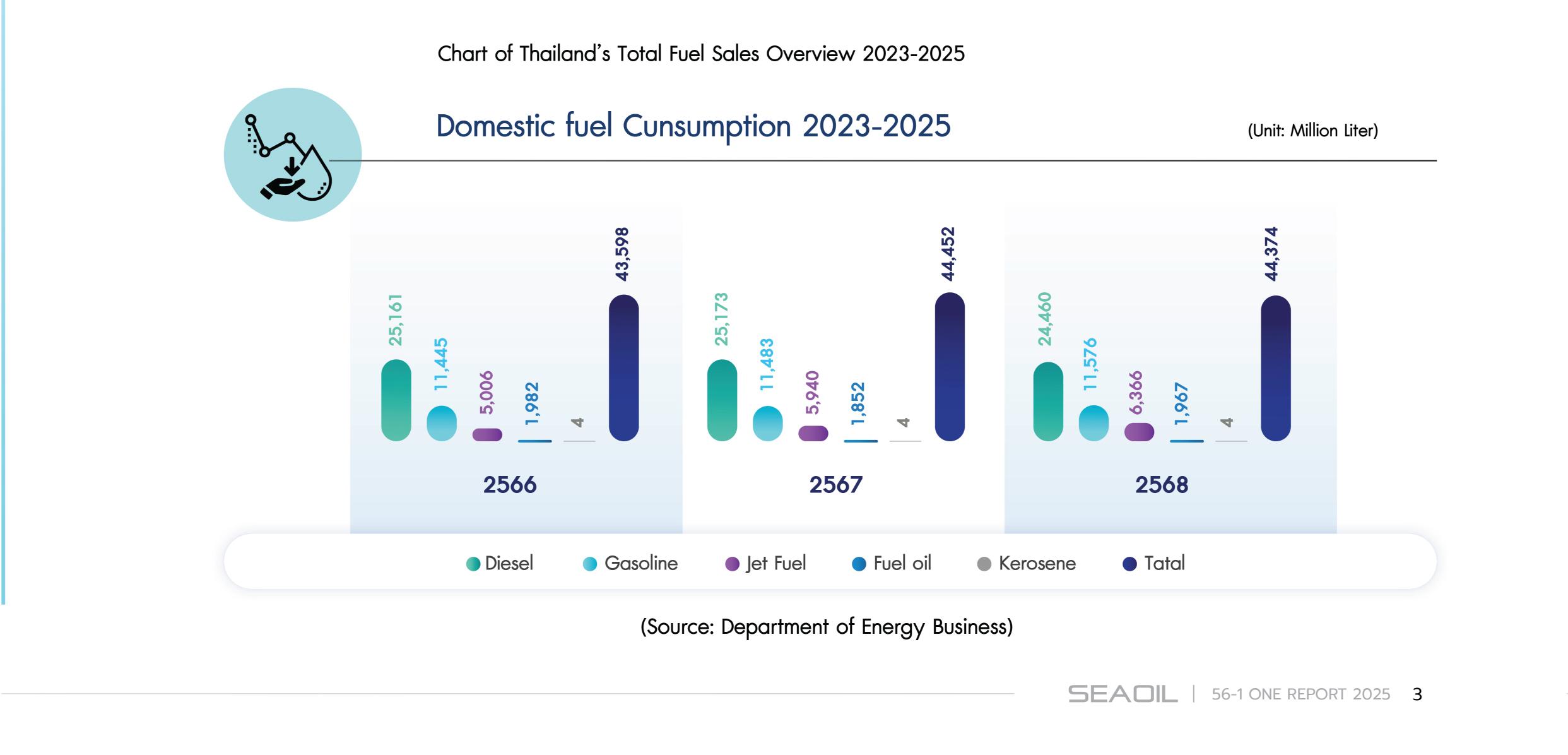
In 2025, total fuel distribution amounted to 44,374 million liters, a slight decrease compared to the previous year. This consisted of Diesel 24,460 million liters, Gasoline 11,576 million liters, Jet Fuel 6,366 million liters, Fuel Oil 1,967 million liters. The majority of the volume increase was in the Jet Fuel category, consistent with the recovery of the tourism sector, while Diesel expanded at a limited rate according to economic activities and the transport sector. However, the growth in oil demand was still affected by several factors, such as adjustments in energy efficiency and global energy price fluctuations. Overall, the trend of oil consumption in Thailand continues to grow at a moderate rate and remains a key factor supporting the business operations of operators in the petroleum product trading industry. Under these circumstances, the Company prioritizes oil price risk management, diversification of procurement sources, and exploring opportunities in the Bioenergy market to maintain operational stability and long-term competitiveness.
Key Events
In 2025, the global energy industry continued to face volatility from economic and geopolitical factors, which influenced oil price trends and the business operations of operators in the petroleum product trading industry. Key factors included production capacity management by the Organization of the Petroleum Exporting Countries and its allies (OPEC+) to maintain global oil price stability, global economic uncertainty stemming from inflation and restrictive monetary policies, and energy demand in the Asian region—particularly China and India—which remained a primary driver of global oil demand. Furthermore, conflicts in the Middle East and the global energy transition remained significant factors affecting the long-term direction of the energy industry.
To support business expansion into the bioenergy market and enhance competitiveness, the Company developed its supply chain management system to align with international standards in 2025. Consequently, the Company received the International Sustainability and Carbon Certification (ISCC), a sustainability standard for bio-based products and bioenergy. This certification facilitates access to international bioenergy markets and strengthens the confidence of partners and stakeholders within the sustainable energy supply chain.
Corporate Social Responsibility (CSR) and Environmental Contributions
In 2025, the Company created value for society, communities, and the environment through various operations and projects, representing a total social, community, and environmental contribution value of 39.82 million Baht.
Supporting a Happy Workplace, ensuring safety and providing learning opportunities for employees.
Providing educational scholarships for underprivileged youth.
Supporting youth with athletic talents.
Promoting knowledge in Safety, Occupational Health, and Environment (SHE) for surrounding communities.
Generating income for communities through local employment.
Supporting the procurement of Green Products (environmentally friendly office supplies).
Developing international environmental standards, including ISO 14001 and ISCC.
Conducting Verification of Corporate Carbon Footprint.
Operating Results & Financial Condition
Operating Results & Profitability
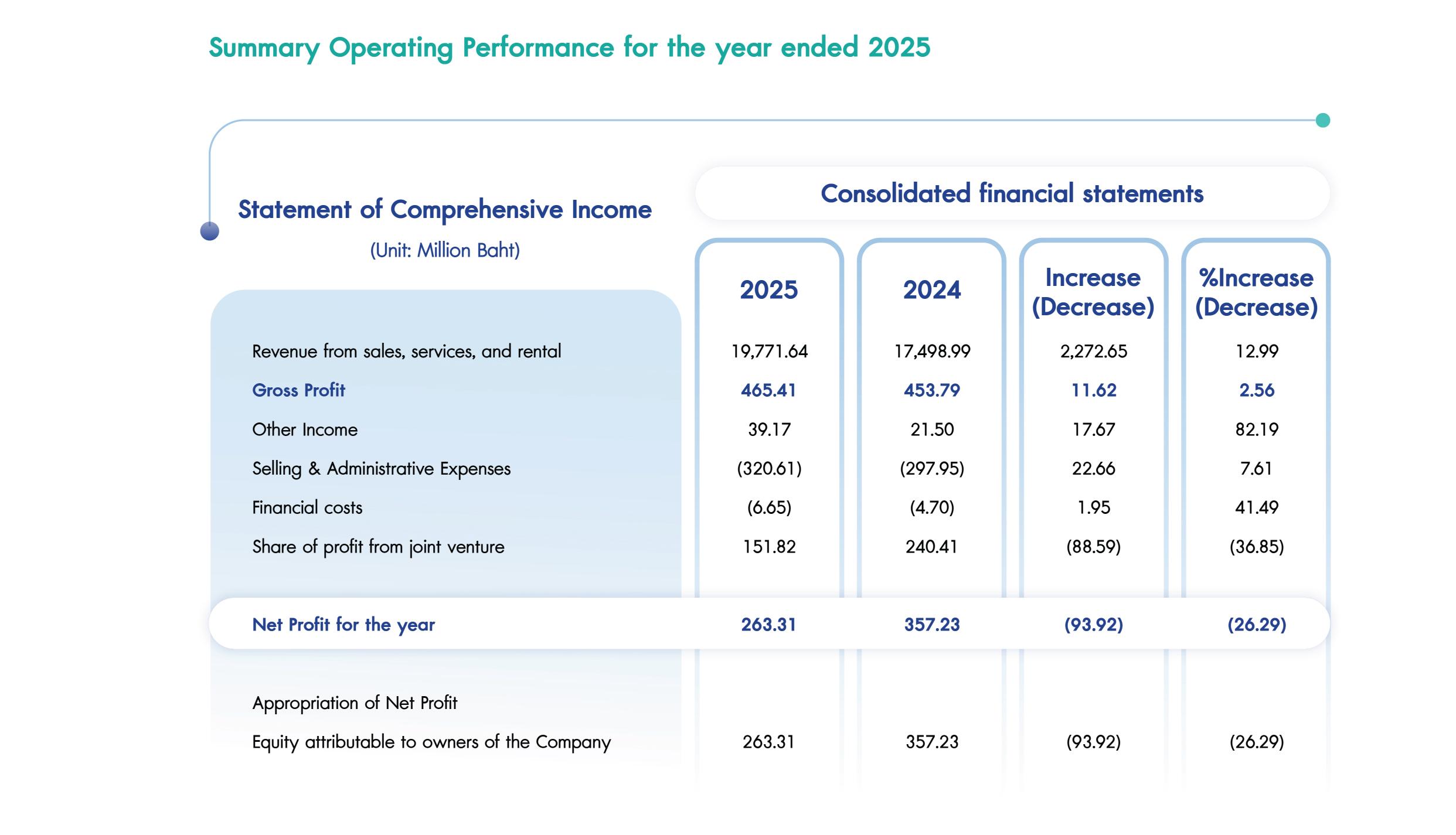
Summary Operating Performance for the year ended 2025
Share of Profit from Joint Venture
The Company and its subsidiaries recognized a share of profit from its joint venture, Pan Orient Energy (Siam) Limited (POES), amounting to 151.82 million Baht, a decrease of 36.85 percent compared to the previous year. This was due to the continuous decline in global crude oil prices from the prior year, resulting in lower oil sales revenue. The average Brent crude oil price in 2025 was approximately 68 USD per barrel, a 12 percent decrease compared to 2024, which had an average price of approximately 79 USD per barrel. Additionally, the production and sales volume of oil decreased by 9.18 percent.
In 2025, POES reported total oil sales revenue of 1,516.19 million Baht before royalties and taxes. The average oil selling price from the onshore concession block L53/48 decreased from the 2024 average to 69.427 USD per barrel, following global oil price trends.
As of 31 December 2025, the Company reported proved oil reserves of 2.519 million barrels, proved plus probable reserves of 3.962 million barrels, and proved plus probable plus possible reserves of 5.689 million barrels. The Company conducted the reserve estimation process in accordance with the standards of the Society of Petroleum Engineers (SPE).
In 2025, POES did not perform any appraisal or production well drilling. However, it conducted 3D seismic reprocessing to enhance drilling precision and the details of reservoir rock layers. The Company also performed workovers on a total of 12 production wells, successfully increasing production rates from existing wells to a satisfactory level.
For the year 2026, POES plans to drill a total of 4 appraisal and production wells during the second and third quarters, and perform workovers on 12 production wells to maintain and increase daily oil production capacity.
Furthermore, regarding the drilling and production operations of POES in block L53/48 in 2025, the Company successfully maintained the safety of all employees, with zero accidents, injuries, illnesses, fatalities, or medical treatment cases, covering a total cumulative working time of 3.4 million man-hours.
Revenue
The Company and its subsidiaries reported total revenue from sales, services, and rentals of 19,771.64 million Baht, an increase of 12.99 percent compared to the previous year. This growth was primarily driven by the increase in revenue and oil sales volume from overseas subsidiaries, which rose by 33.70 percent and 66.44 percent, respectively, compared to the prior year.
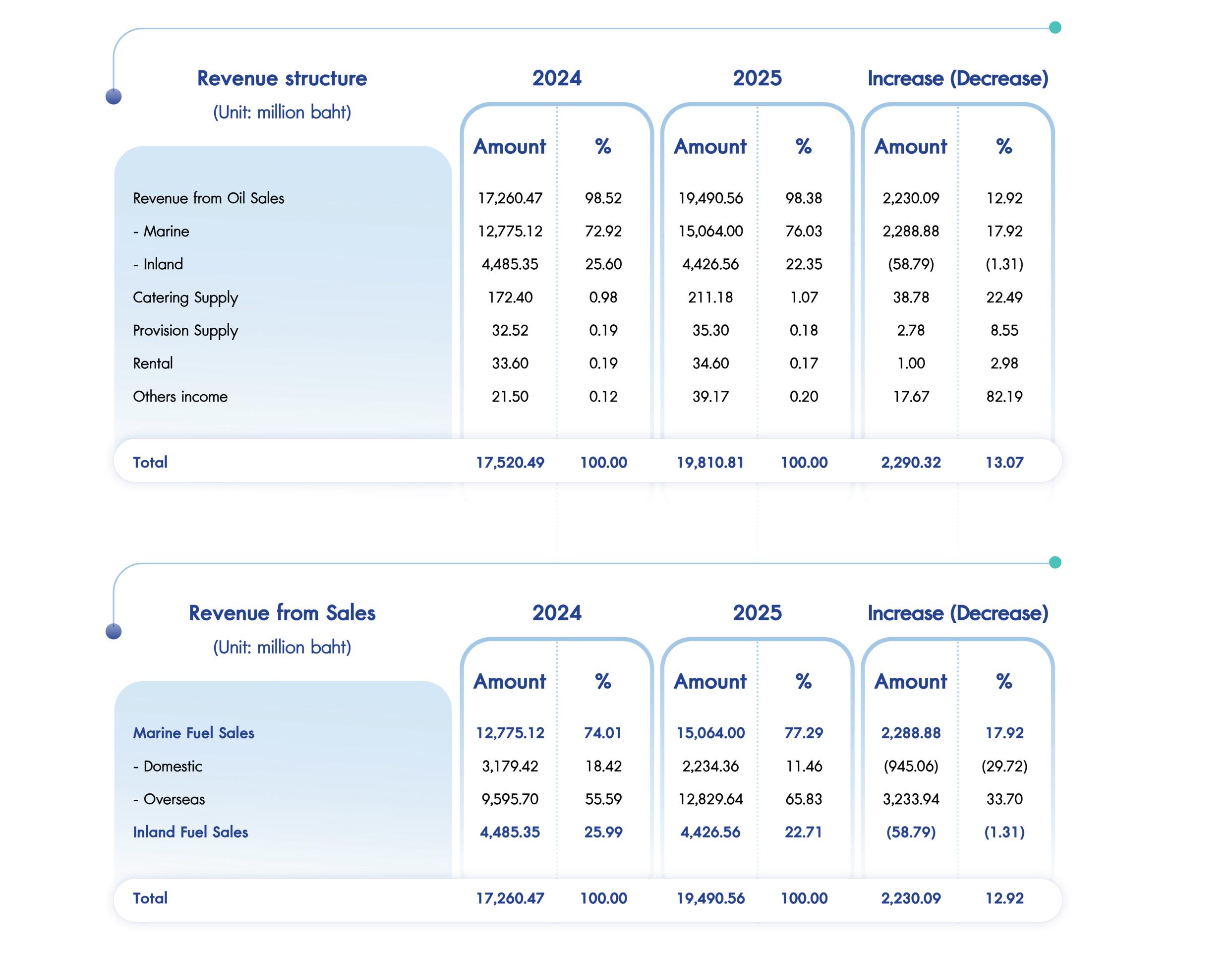
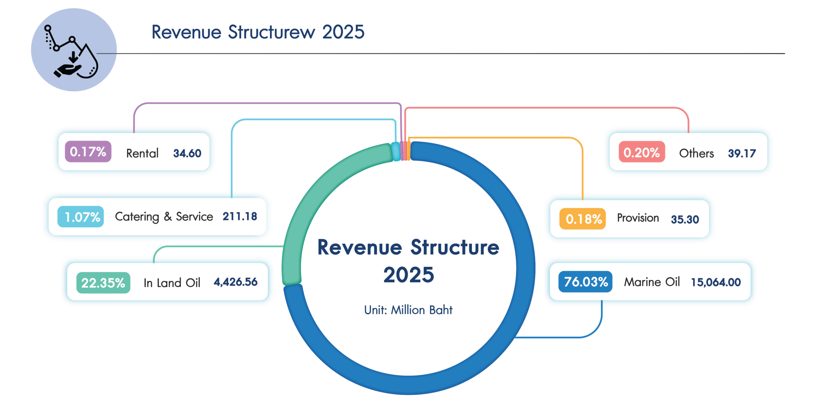
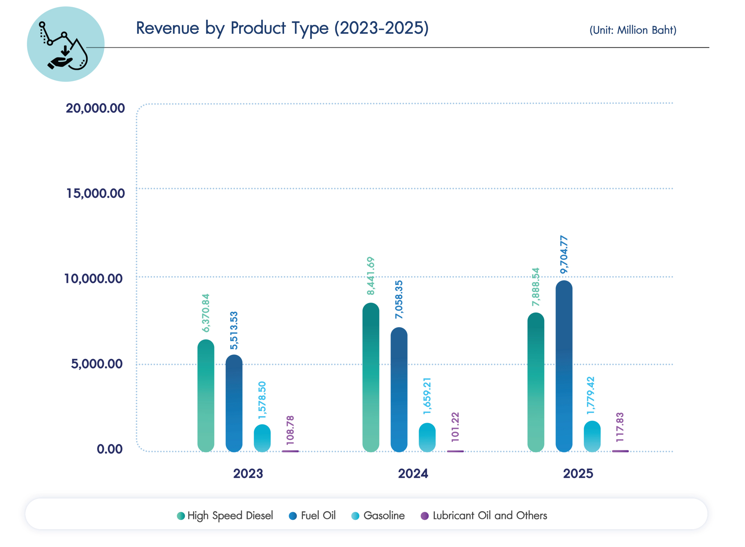
In 2025, revenue from oil sales of the Company and its subsidiaries amounted to 19,490.56 million Baht, an increase of 12.92 percent from 2024. This increase was primarily driven by the growth in revenue and sales volume to overseas customer groups, particularly through international marine sales channels, which saw a revenue increase of 33.70 percent. Conversely, revenue from domestic oil sales across both marine and inland channels declined, consistent with the downward trend of market oil prices. However, domestic oil sales volume still increased by 3.23 percent compared to the previous year.
Revenue from Oil Sales by Product
The revenue from oil sales of the Company and its subsidiaries, categorized by product type in 2025, is as follows:
High Speed Diesel (HSD): The Company’s revenue from High Speed Diesel sales amounted to 7,888.54million Baht, accounting for 40.48percent of total oil sales revenue. The sales volume of High Speed Diesel in 2025was 380.09million liters, mainly generated from marine sales to international customers.
Fuel Oil: In 2025, revenue from Fuel Oil sales was 9,704.77million Baht, representing 49.79percent of total oil sales revenue. The sales volume of Fuel Oil in 2025was 618.46million liters, primarily resulting from marine sales to international customers and transport vessels.
Gasoline: Revenue from Gasoline sales in 2025 amounted to 1,779.42 million Baht, accounting for 9.13 percent of total oil sales revenue. The sales volume of Gasoline in 2025 was 103.14 million liters, which was generated from inland export sales to international customers.
Revenue from Catering & Supply Management Business
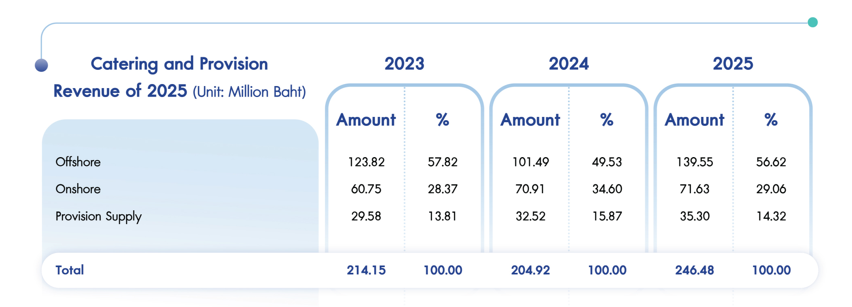
The Company generates service revenue from catering, provisioning, and other related services for personnel at both offshore and onshore oil and gas rigs (Catering & Supply Management). This includes revenue from catering, cleaning, and laundry services for personnel on offshore rigs in the Gulf of Thailand, accommodation vessels, and onshore drilling sites (Catering and Housekeeping Services), as well as the procurement of provisions, food, raw materials, and other services (Provision Supply) for various fleets.
In 2025, revenue from the Catering & Supply Management business amounted to 211.18 million Baht, an increase of 22.49 percent from 2024. This growth was due to the return to service of an accommodation vessel after an off-hire period for scheduled dry docking and maintenance of the Accommodation Work Barge (AWB).
Revenue from Provision Supply in 2025 was 35.30 million Baht, an increase of 8.55 percent from 2024, driven by an increase in large oil tankers entering the country to receive goods and requiring more provision supplies compared to the previous year.
Other Income
The Company and its subsidiaries reported other income of 39.17 million Baht, an increase of 17.67 million Baht or 82.19 percent compared to the previous year. Other income in 2025 primarily resulted from compensation received from Natural Energy Refinery Holding due to non-compliance with a subsidiary's ordinary share purchase agreement, as well as an increase in interest income from financial institutions.
Cost of Sales and Services, and Gross Profit
Cost of sales consists of the cost of oil sales, while cost of services arises from the Supply Management business.
In 2025, the cost of sales for fuel and lubricants amounted to 19,115.66 million Baht, representing 97.90 percent of oil sales revenue. Consequently, the Company and its subsidiaries reported a gross profit from oil sales of 410.20 million Baht, a decrease of 2 million Baht or 0.49 percent from 2024. This was due to price competition in both domestic and international oil markets, combined with lower market oil prices compared to the previous year. However, the total oil sales volume to domestic and international customers increased by 40.82 percent in 2025.
The service costs for the Catering & Supply Management business in 2025 totaled 169.07 million Baht, or 80.06 percent of total service revenue. This resulted in a gross profit from services of 42.12 million Baht, a 37.97 percent increase from 2024, as the Company managed and controlled service costs more efficiently.
Gross Profit
The Company and its subsidiaries reported a total gross profit of 465.41 million Baht, an increase of 11.63 million Baht or 2.56 percent compared to the same period last year. This was mainly driven by the gross profit from the Catering & Supply Management business due to improved cost control.
Expenses
Selling and administrative expenses amounted to 320.61 million Baht, an increase of 22.66 million Baht or 7.61 percent year-on-year. This increase was primarily due to employee-related expenses and marketing costs of overseas subsidiaries, consistent with the growth in revenue and oil sales volume from those subsidiaries.
Finance Costs
In 2025, finance costs totaled 6.65 million Baht, an increase of 1.95 million Baht or 41.49 percent compared to the previous year, resulting from interest on loans from financial institutions by overseas subsidiaries.
Assets
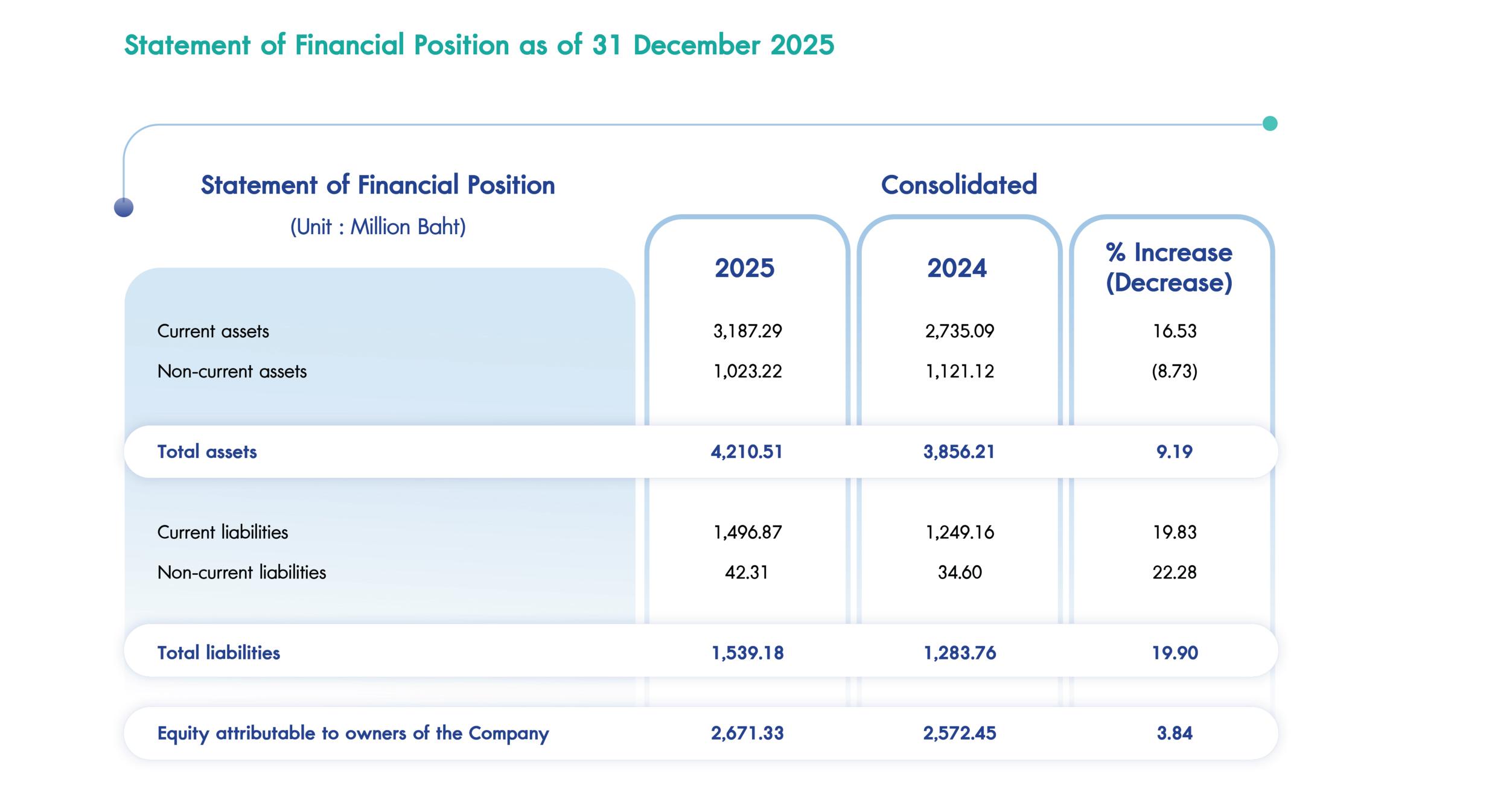
The Company and its subsidiaries reported total assets of 4,210.51 million Baht, an increase of 354.30 million Baht or 9.19 percent compared to the end of 2024. This was primarily driven by an increase in current assets of 452.20 million Baht, or 16.53 percent, resulting from higher cash and cash equivalents, as well as trade and other current receivables.
Liabilities
The Company and its subsidiaries had total liabilities of 1,539.18 million Baht, an increase of 255.42 million Baht or 19.90 percent compared to the end of 2024. The increase was mainly due to higher current liabilities, specifically in trade and other current payables.
Shareholders’ Equity
The Company and its subsidiaries reported shareholders’ equity of 2,671.33 million Baht. Total shareholders’ equity increased by 98.88 million Baht or 3.84 percent from the end of 2024, primarily due to an increase in total comprehensive income.
As of December 31, 2025, the total registered ordinary shares numbered 738,984,544 shares with a par value of 1 Baht per share (End of 2024: 738,984,544 shares at 1 Baht per share). The issued and fully paid-up share capital amounted to 738,981,791 Baht (End of 2024: 738,981,791 Baht).
Net Cash from Operating Activities
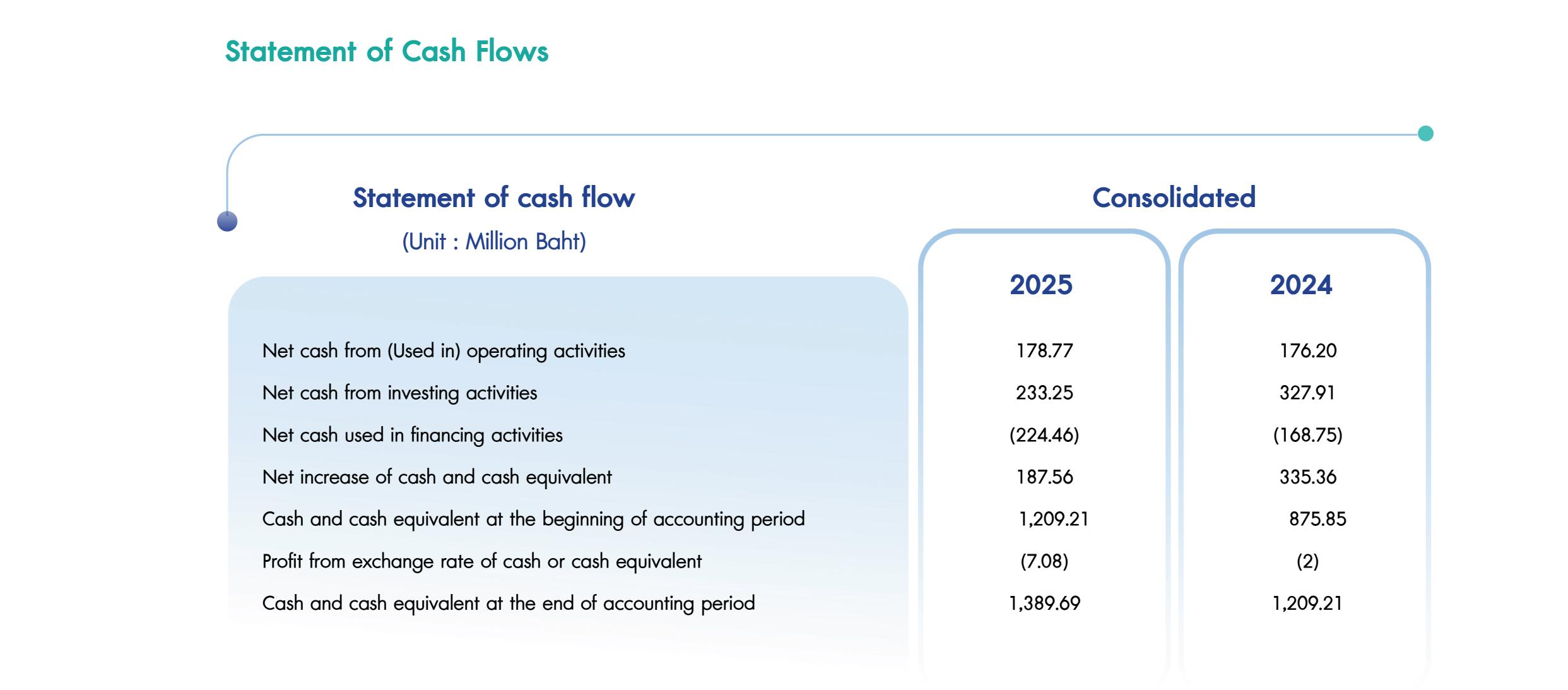
In 2025, the Company and its subsidiaries had net cash provided by operating activities of 178.77 million Baht, an increase from 2024. This was primarily due to a decrease in trade and other receivables.
Net Cash Used in Financing Activities
In 2025, net cash provided by investing activities amounted to 233.25 million Baht, largely driven by dividend income received from the joint venture, POES.
Cash Flow from Financing Activities
In 2025, the Company and its subsidiaries reported net cash used in financing activities of 224.46 million Baht. This was primarily attributed to the repayment of loans from financial institutions, interest payments, and dividend distributions to shareholders.
As a result of the aforementioned cash flow activities, the Company and its subsidiaries recorded a net increase in cash and cash equivalents of 187.56 million Baht compared to the end of 2024. Consequently, as of December 31, 2025, the Company and its subsidiaries held cash and cash equivalents of 1,389.69 million Baht.
Debt Securities with Financial Ratio Requirements
Debt Securities with Financial Ratio Requirements Issued?
No
Factors That May Affect Financial Condition
Factors or Incidents That May Materially Affect Financial Condition
Economic Outlook for 2026
The Office of the National Economic and Social Development Council (NESDC) forecasts that the Thai economy in 2026 will likely expand at a slower pace compared to 2025. The primary drivers for growth include the continued recovery of the tourism and related service sectors, as well as investments from both the public and private sectors.
However, the Thai economy remains challenged by global economic uncertainty, international financial market volatility, and geopolitical conflicts across various regions. These factors could impact energy price trends specifically global oil prices as well as the export and logistics sectors. Consequently, these variables may cause fluctuations in economic expansion and certain business activities, which may not align with previous projections.
Factors and Influences Affecting Future Operations or Financial Position
The business outlook for 2026 continues to be influenced by the global and Asian economic landscapes, shifts in the energy industry—particularly global oil price volatility—and geopolitical tensions. Nevertheless, energy demand is expected to grow in line with the recovery of economic activities, which serves as a supportive factor for the overall energy business.
The Company closely monitors and assesses these factors, managing cost volatility through a Cost Plus Pricing Method combined with continuous supply chain management and operational efficiency improvements. Furthermore, the Company manages Emerging Risks, such as climate change, the transition to a low-carbon economy, and technological shifts.
The Company is committed to operating under the principles of Good Corporate Governance, taking all stakeholders into account while managing impacts on society, the community, and the environment to support stable and sustainable long-term organizational growth.
(For further details, please refer to Part 1: Business Operations and Performance, Section 1.3: Driving Business for Sustainability)